
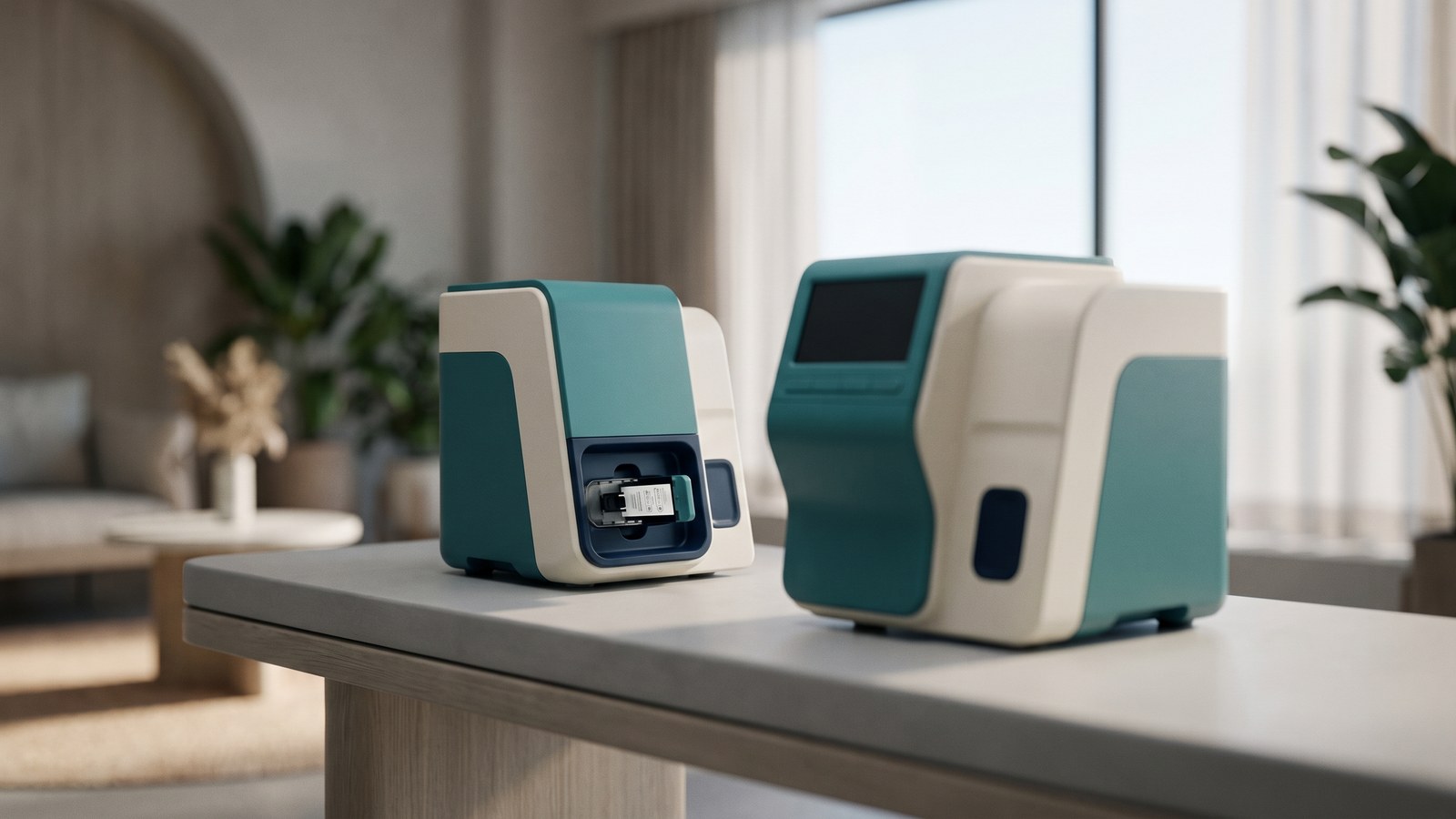
A patient sat in your clinic four weeks ago and the analyser read 53 mmol/mol. This week the hospital laboratory reports 48. Their treatment has not changed, yet the two numbers tell slightly different stories, and you are left explaining the gap to someone who just wants to know if they are doing well. If your clinic runs point-of-care HbA1c, you have almost certainly had this conversation.
The reassuring part is that this kind of disagreement is documented, mostly predictable and manageable. This article explains why two analysers can produce different HbA1c values for the same blood, what the accuracy rules actually expect, where point-of-care testing is sound and where it is not, and the everyday habits that protect point-of-care HbA1c accuracy so your results stay defensible.
Why the same patient can give two HbA1c numbers
Two HbA1c results rarely match to the decimal. There are three honest reasons.
Method differences and calibration
HbA1c can be measured by several chemistries, including ion-exchange separation, boronate affinity, immunoassay and enzymatic methods. Each is calibrated to a common reference, but they do not all respond identically to the same sample. A small, consistent offset between two methods is called bias, and it is normal. Your point-of-care device and the central laboratory may sit a couple of mmol/mol apart simply because they use different chemistries.
Imprecision and the limits of repeatability
Run the same sample ten times and you will get a spread of results, not one value. That spread is imprecision, usually expressed as a coefficient of variation (CV). Many laboratories aim for an analytical CV below 2% for HbA1c. At 50 mmol/mol, a 2% CV means roughly plus or minus 1 mmol/mol from imprecision alone, before any method bias is added.
Biological and pre-analytical variation
The patient changes too. HbA1c reflects average glucose over the preceding 8 to 12 weeks, so genuine shifts happen between visits. Sampling, handling and timing add small amounts of variation on top.
Put together, a difference of a few mmol/mol between two well-run analysers is often expected, not a fault. The skill is telling ordinary variation apart from a real problem.
What the NGSP criteria expect from point-of-care HbA1c accuracy
HbA1c is one of the most tightly standardised tests in the laboratory. The National Glycohemoglobin Standardization Program (NGSP) anchors methods to a common reference so that results are comparable between sites and over time. The IFCC reference system underpins the mmol/mol units now used across the UK.
To earn NGSP certification, a manufacturer must show that a large majority of its results fall within roughly 6% of the designated comparison method. In practice that means a true value of 50 mmol/mol could read acceptably across a band of several mmol/mol on a certified device. Knowing that band exists is what stops a small, in-spec difference from being treated as a crisis.
You can see typical reference points, units and clinical context for this marker in the HbA1c entry in the POCTIFY Analyte Explorer, and the related glucose entry for everyday monitoring.
Monitoring versus diagnosis: where point-of-care HbA1c fits
This is the distinction that matters most for day-to-day practice.
For monitoring people who already have diabetes, point-of-care HbA1c is well suited. You are watching a trend in the same patient over months, the clinical decisions tolerate a few mmol/mol of variation, and the immediate result supports the conversation in the room.
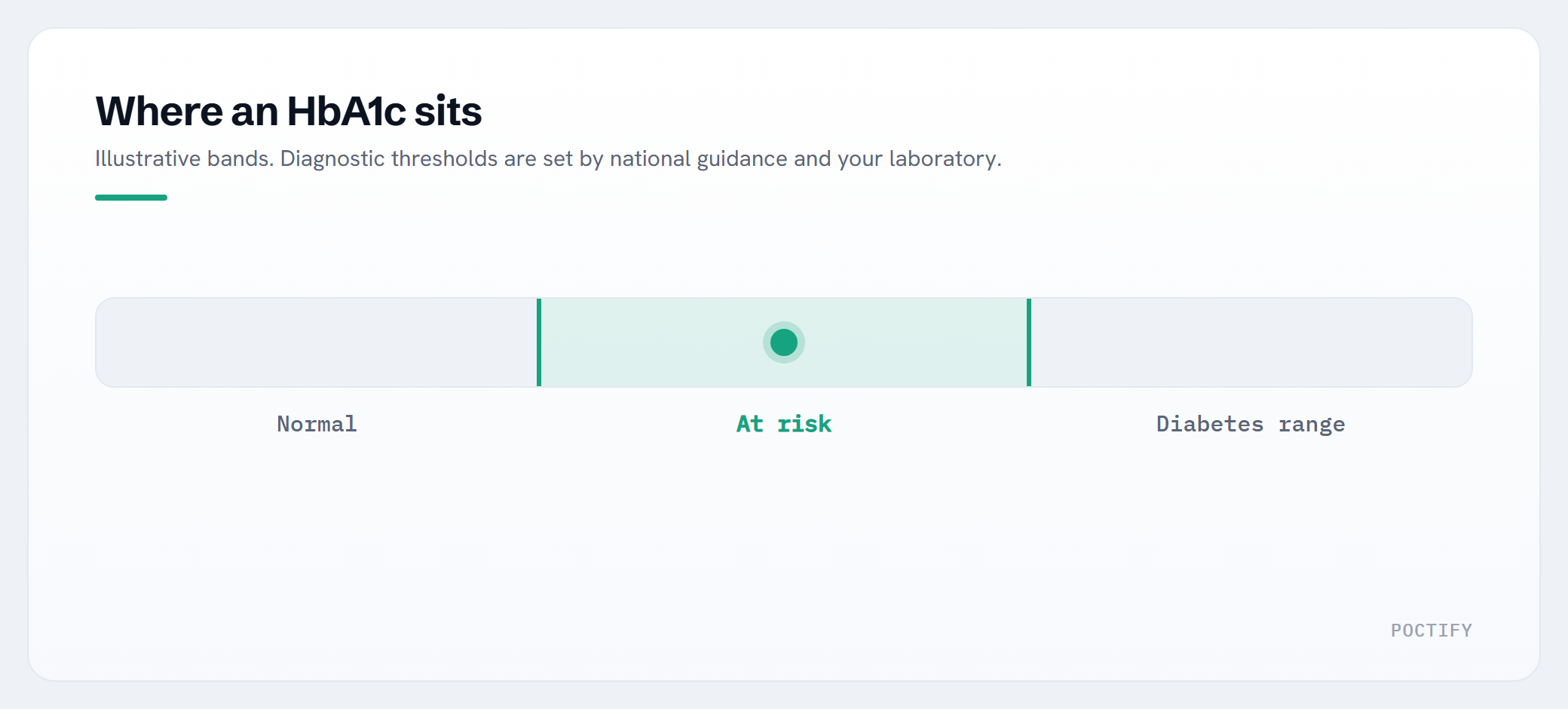
Diagnosis sits at a higher bar. The threshold of 48 mmol/mol (6.5%) is a hard line, and a result of 47 versus 49 changes the label. Major guidance, including the World Health Organization (2011) and successive diabetes standards of care, advises that a new diagnosis should rest on a quality-assured laboratory method, and that point-of-care HbA1c should not be used to diagnose diabetes unless the specific device and setting meet stringent analytical and quality-assurance standards. Independent evaluations published in Clinical Chemistry (2010 and 2014) found that some point-of-care HbA1c analysers met accepted performance goals while others did not, which is exactly why device selection and ongoing quality control matter.
A practical rule: use point-of-care HbA1c to monitor with confidence, and confirm a new diagnosis with the laboratory.
Interferences that change the number whatever the machine
Some disagreements are not about the analyser at all. They are about the blood.
Haemoglobin variants and raised fetal haemoglobin
Variants such as HbS, HbC, HbE and HbD, and a raised level of fetal haemoglobin (HbF), can interfere with HbA1c measurement. The effect depends on the method: a variant that disturbs one chemistry may not trouble another. The NGSP publishes method-specific interference information, and it is worth knowing which variants affect your particular device. If a result looks implausible against a patient’s home glucose readings, a variant is one explanation to consider.
Anything that changes red cell lifespan
HbA1c assumes a roughly normal red cell lifespan of about 120 days. Conditions that shorten it, such as haemolytic anaemia, recent blood loss or some medicines, tend to lower HbA1c. Conditions that lengthen it, such as iron deficiency, can raise it. Pregnancy, chronic kidney disease and erythropoietin treatment all shift the relationship between average glucose and HbA1c.
Recent transfusion and other red flags
A recent blood transfusion introduces donor haemoglobin and makes HbA1c unreliable for a period, regardless of how good the analyser is. In these situations HbA1c may not be the right test at all, and that is a clinical judgement for the responsible clinician rather than a calibration issue.
QC, lot tracking and EQA: the habits that keep results defensible
If you cannot show that the analyser was performing on the day a result was produced, the number is hard to defend. Three habits do most of the work.
Quality control that catches drift
Run internal quality control at the intervals set by the manufacturer and your local policy, using at least two levels that bracket the clinical decision points. The value of QC is not the single pass or fail. It is the trend. Plotting results over time on a control chart lets you see an analyser sliding before it crosses a limit. A run of results creeping in one direction is an early warning, even while every point is still technically in range.
Track every reagent and cartridge lot
Lot-to-lot variation is a real and underrated cause of sudden steps in results. When a new cartridge or reagent lot comes into use, verify performance before relying on it, and record the lot number against the results it produced. If a shift appears the day a lot changed, you have your suspect immediately. Without lot records, you are guessing.
External quality assessment and method comparison
Internal QC tells you the analyser is consistent. External quality assessment (EQA), sometimes called proficiency testing, tells you it is correct. Enrol the device in a recognised HbA1c EQA scheme, review how you compare with the reference and your peer group, and act on any flag. Periodically comparing a handful of patient samples against your local laboratory is a simple, persuasive check that your point-of-care results and the lab agree within the expected window. These practices also align with the expectations of ISO 15189:2022, the standard covering quality in medical laboratories including point-of-care testing. We name it here only as a pointer: consult the official ISO text for the precise requirements.
Operator competency belongs in the record too
A correct result on a well-maintained analyser can still go wrong in untrained hands. Recording who ran each test, and keeping training and competency current, closes the last gap between a good device and a defensible result.
How POCTIFY helps you catch a drift early
POCTIFY provides digital solutions for point-of-care testing, tailored to each clinic. For HbA1c that means keeping a clear record of each result alongside the reagent or cartridge lot and the operator who ran it, so QC trends, lot changes and operator patterns sit in one place rather than across paper logs. When an analyser starts to drift, or a new lot nudges results, the pattern is visible early instead of after a patient has been given a number you cannot stand behind. It works with the devices and systems you already use, so the habits above become routine rather than extra paperwork.
The bottom line
Two HbA1c machines disagreeing is usually method bias, ordinary imprecision or a genuine change in the patient, not a failure. Point-of-care HbA1c is sound for monitoring and should be confirmed in the laboratory for a new diagnosis. Watch for haemoglobin variants and red cell conditions, and keep QC trends, lot records and EQA current, so that when a result is questioned you can show it was sound.
This article is for education and operational guidance only. It is not medical advice and does not replace clinical judgement or your local protocols. Decisions about diagnosis and treatment rest with the responsible clinician.
If you would like to talk through tracking results, lots and QC for your own analysers, Talk to POCTIFY for tailored support.
Frequently asked questions
Can I use point-of-care HbA1c to diagnose diabetes?
It is best suited to monitoring people who already have diabetes. Most guidance advises confirming a new diagnosis with a quality-assured laboratory method, because the 48 mmol/mol (6.5%) threshold is a hard line and small analytical differences can change the result. Use a point-of-care device for diagnosis only if it meets stringent standards and your quality assurance supports it. This is educational information, not medical advice.
How much difference between two HbA1c results is normal?
A few mmol/mol is often expected. NGSP-certified methods are allowed to differ from a reference by roughly 6%, and analytical imprecision adds about plus or minus 1 mmol/mol at 50 mmol/mol. Genuine biological change between visits adds more on top. A consistent, growing gap is more concerning than a one-off small difference.
Which patients can get an unreliable HbA1c?
Anyone whose red cell lifespan is altered, including people with haemolytic anaemia, recent blood loss, iron deficiency, chronic kidney disease or pregnancy, and anyone with a haemoglobin variant or a recent blood transfusion. In these cases HbA1c may not reflect average glucose, whatever the analyser, and a different test may be more appropriate.
How often should we run HbA1c quality control?
Follow the manufacturer’s instructions and your local policy, run at least two control levels that bracket the decision points, and test any new reagent or cartridge lot before relying on it. Just as important, trend the results over time so you can see an analyser drifting before a control actually fails.
What is EQA and do we need it for HbA1c?
External quality assessment (EQA), or proficiency testing, sends you blind samples and compares your result with a reference and a peer group. Internal QC shows your analyser is consistent. EQA shows it is correct. Enrolling in a recognised HbA1c scheme is part of keeping results defensible and supports accreditation.