
Warfarin caseloads persist, and the paper trail is thinning
Even as direct oral anticoagulants take a share of new prescriptions, a sizeable group of patients stays on warfarin and other vitamin K antagonists: mechanical heart valve recipients, people with antiphospholipid syndrome, some patients with renal impairment, and stable patients who simply do not want to switch. Each one needs an INR result on a schedule, a dose decision recorded against it, and a clear date for the next test.
When that cycle is spread across paper diaries, voicemail and a venous sample taken at a clinic several miles away, two things suffer: the patient’s time in range, and your ability to show exactly why each dose was set. INR self-testing at home can improve both, but only if you are clear about which model you are running and how you capture the data it produces.
Self-testing and self-management are not the same thing
Both pathways begin identically. The patient performs a capillary fingerstick on a point-of-care INR meter at home and reads a result in roughly a minute. What happens after that result appears is the dividing line, and it is the source of most of the confusion.
Self-testing: the patient measures, the clinic decides
In self-testing, the patient reports the INR value to the anticoagulation service and a clinician or clinical pharmacist sets the warfarin dose and the next test date. The patient owns the measurement. The service owns the clinical decision. This is the more cautious model, and most programmes sensibly start here.
Self-management: the patient measures and adjusts
In self-management, the trained patient measures the INR and adjusts their own warfarin dose against an agreed protocol, contacting the service only when a result falls outside set limits or a clinical event occurs. It asks more of the patient and far more of the training and governance behind them, but for stable, capable patients it can cut routine clinic contacts sharply.
The research literature groups both under the single heading of self-monitoring. That is convenient for meta-analysis and unhelpful at the front desk. For enrolment, training and clinical responsibility, keep them as two separate pathways.
Who is suitable for each
Suitability is about capability and risk, not enthusiasm alone. For point-of-care INR with warfarin, a candidate generally needs reasonable dexterity for the fingerstick, adequate eyesight, the cognitive ability to follow a protocol, and a willingness to test on schedule. A carer can perform testing where the patient cannot.
Self-testing suits patients who can produce and report a reliable result but should not, or do not wish to, make dosing decisions. Self-management suits a narrower group: stable patients with a track record of good control who have completed structured education and can demonstrate correct technique and sound dose decisions before you hand over that responsibility. Mechanical heart valve patients, who face tight targets and serious consequences from drift, are often strong candidates for self-monitoring precisely because they test for years and value the autonomy.
Whichever model you choose, document the competency assessment, the protocol the patient is working to, and the escalation thresholds. That record is part of your clinical governance, not an optional extra.
More frequent testing improves time in therapeutic range
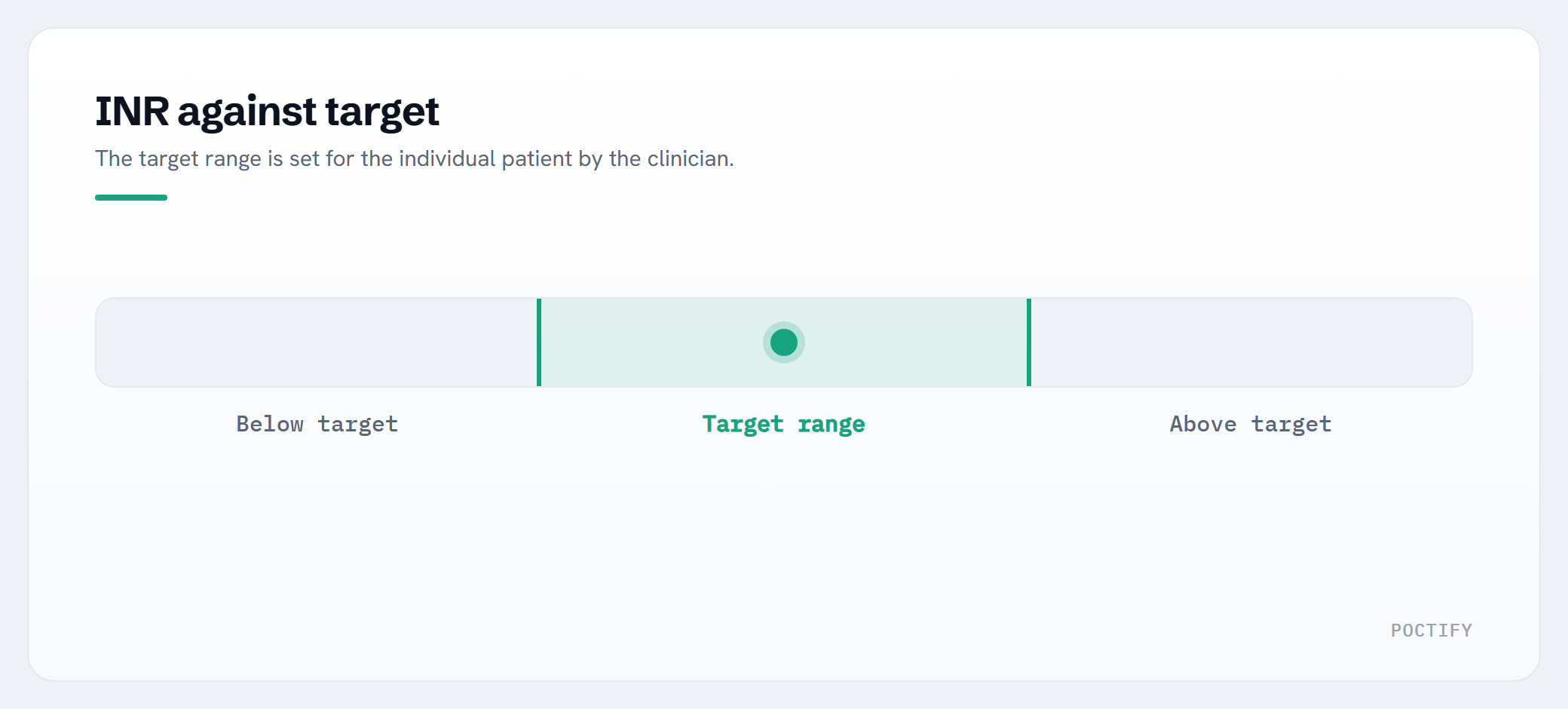
This is where the evidence is strongest. The headline measure for anticoagulation control is time in therapeutic range (TTR), usually calculated by linear interpolation between successive INR readings, which estimates the proportion of time a patient’s INR sits within their target band. That band is commonly 2.0 to 3.0 for atrial fibrillation and venous thromboembolism, and higher for some mechanical valves. Most services treat a TTR above roughly 65 to 70 per cent as the threshold for acceptable control.
Home testing raises TTR mainly by raising frequency. Weekly capillary testing catches an INR drifting out of range far sooner than a sample taken every four to six weeks, so corrections happen earlier and excursions are shorter.
The outcome evidence backs this up. An individual patient data meta-analysis published in The Lancet in 2012, pooling eleven trials and more than six thousand patients, found that self-monitoring roughly halved thromboembolic events, with the largest benefit in younger patients and those with mechanical heart valves. A Cochrane systematic review reached broadly similar conclusions on thromboembolism. In England, NICE diagnostics guidance DG14 (2014) supported self-monitoring with point-of-care meters for suitable patients on long-term vitamin K antagonists who have atrial fibrillation or heart valve disease and can use the device reliably. You can read more about what INR measures and how it is reported in our Analyte Explorer.
The operational core: recall, result capture, and a clean dosing trail
A home-INR programme is only as safe as the system wrapped around the meter. The clinical case for home testing is settled. The reason programmes wobble is almost always operational: a missed test that nobody chased, a result texted to a personal phone and never filed, or a dose change that cannot be traced back to the value that prompted it.
Recall that does not depend on memory
Frequent testing only helps if the tests actually happen. Manual recall by spreadsheet and phone call is the first thing to break as a caseload grows. A dependable programme schedules the next test at the moment a result is filed, flags overdue patients automatically, and escalates the ones who go quiet, so a missed week becomes a task rather than a gap nobody noticed.
Result capture you can trust
A reported INR is only useful if you know it is the right value, for the right patient, on the right date. Hand-keying numbers from a phone message invites transposition errors and uncertainty about timing. Capturing each result with the patient identifier, the value, the date and the device that produced it removes that doubt and gives you a clean dataset for TTR reporting. POCTIFY works with the devices and systems you already use, so capture fits your meters rather than forcing a change of kit.
A dosing record that tells the whole story
In any anticoagulation service, and especially in self-management, you need to show the line from result to decision: this INR, on this date, led to this dose and this next test date, set by this clinician or by the patient under this protocol. When that chain is complete, audit, incident review and continuity between staff all become straightforward. When it is scattered, every query turns into detective work. Consistent quality assurance underpins the whole record, and our guide to quality control for point-of-care testing covers the checks that keep home results credible.
Building a home-INR workflow that holds up
Start by choosing the model deliberately. Enrol most patients into self-testing, reserve self-management for those who earn it through structured education and assessment, and write down the protocol and escalation limits for each. Then put the operational spine in place before you scale: scheduled recall, clean result capture, and a dosing record that links every decision to the value behind it. Get those three right and frequent INR self-testing at home becomes a measurable gain in time in range rather than an administrative burden.
This article is for educational and operational purposes only. It is not medical advice and does not direct diagnosis, dosing or treatment for any individual. Always follow your local anticoagulation protocols and the manufacturer instructions for use for your devices.
Talk to POCTIFY
If you are building or tightening a home-INR monitoring workflow, we can help you map recall, result capture and the dosing trail around the devices you already run. Talk to POCTIFY for a tailored walkthrough, with no pressure and no obligation.
Frequently asked questions
What is the difference between INR self-testing and self-management?
In self-testing the patient measures their own INR at home and reports it, while a clinician or pharmacist decides the warfarin dose. In self-management the trained patient both measures the INR and adjusts the dose against an agreed protocol, contacting the service only for out-of-range results or clinical events.
Does home INR testing improve time in therapeutic range?
Yes. Testing more often catches an INR drifting out of range earlier, so corrections happen sooner. An individual patient data meta-analysis (The Lancet, 2012) found self-monitoring roughly halved thromboembolic events, with the greatest benefit in younger patients and those with mechanical heart valves.
Who is suitable for INR self-management?
Stable patients with a record of good control who have completed structured education and can demonstrate correct fingerstick technique and sound dose decisions. A carer can test where the patient cannot. Document the competency assessment, the protocol and the escalation limits.
What INR range are home testers aiming for?
Commonly 2.0 to 3.0 for atrial fibrillation and venous thromboembolism, with higher targets for some mechanical heart valves. Services usually treat a time in therapeutic range above about 65 to 70 per cent as acceptable control. Individual targets are set by the clinical team.
How often should patients on warfarin test at home?
Many self-monitoring patients test weekly, which detects drift sooner than testing every four to six weeks. The exact interval depends on the patient’s stability and local protocol, and may change after a dose adjustment.
What makes a home-INR programme safe operationally?
Reliable recall so tests are not missed, accurate result capture tied to patient, date and device, and a dosing record that links every dose to the result that prompted it. Without these three, frequent testing does not reliably translate into better control.