

It is the middle of a winter clinic. A patient with three days of cough and a little breathlessness wants to know whether they need antibiotics. Your examination is reassuring but not conclusive. The waiting room is full, the patient is worried, and the option that feels safest in the moment, a prescription, is also the one that adds to antibiotic resistance and may do nothing for them. A C-reactive protein (CRP) reading in front of you would make that decision clearer. The real questions are what the number actually tells you, and whether your service is set up so the result carries any weight.
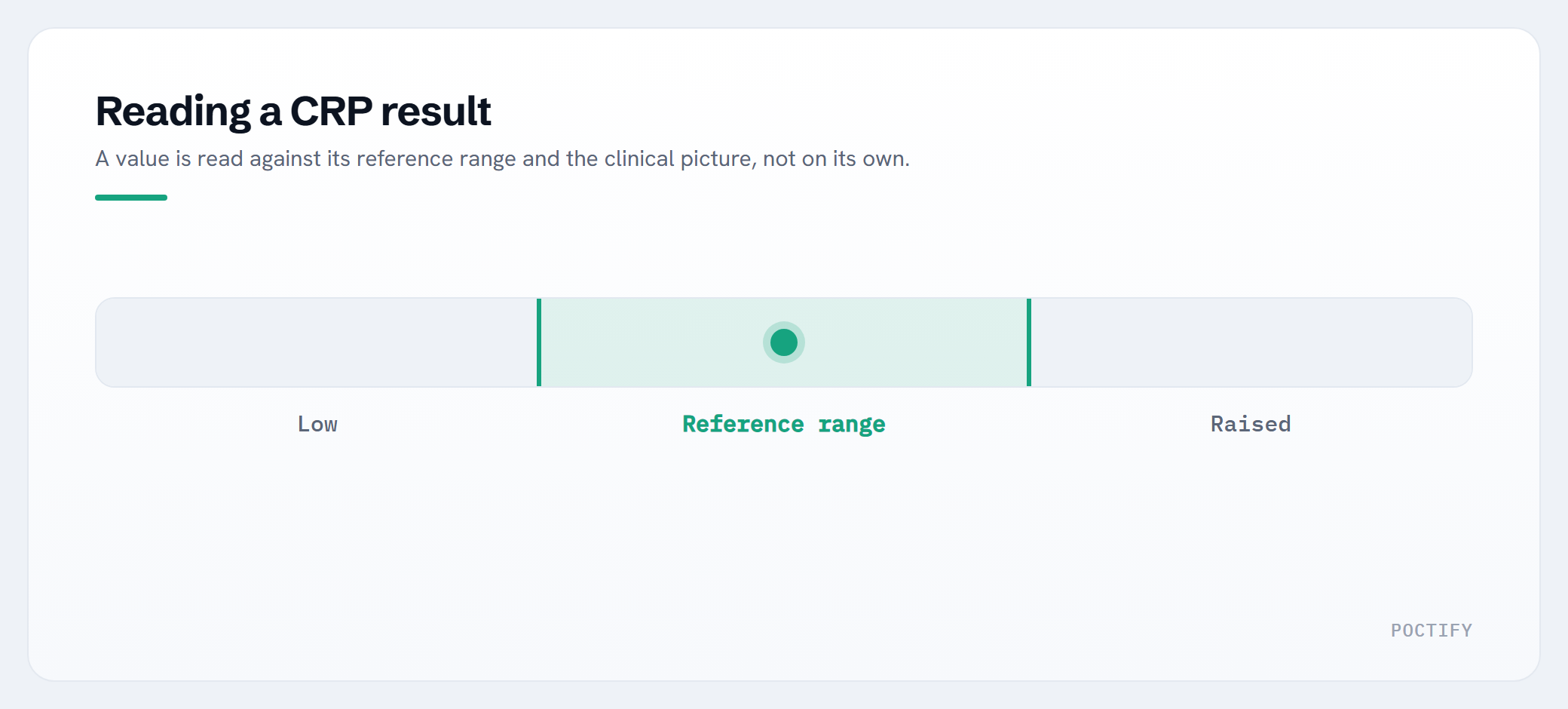
This article explains what point-of-care CRP testing measures, how to read the low, intermediate and high bands in plain terms, what the evidence says about safer prescribing, and the operational detail that decides whether a CRP changes anything at all.
What point-of-care CRP testing measures, and why it helps in respiratory illness
CRP is a protein the liver releases in response to inflammation. Levels rise within hours of a significant bacterial infection and fall as it settles, which makes CRP a useful marker of how much inflammation is present right now. In primary care it is used most often to help separate self-limiting viral respiratory illness, where CRP usually stays low, from lower respiratory tract infection that might benefit from antibiotics, where CRP tends to run higher.
Point-of-care CRP testing brings that measurement into the consultation itself. A fingerprick sample gives a result in a few minutes, while the patient is still in front of you, rather than days later when the prescribing decision has already been made. That timing is the whole point. A number that arrives after the patient has left changes nothing.
Reading the bands: low, intermediate and high
National guidance in the UK describes three broad CRP bands for adults presenting with symptoms of lower respiratory tract infection, where pneumonia is not already clinically suspected. The thresholds below are widely used, but they apply to specific situations and never stand in for clinical assessment.
Low: under 20 mg/L
A low result points away from a bacterial cause. Guidance indicates antibiotics are not routinely needed in this band, so the conversation can move towards self-care, realistic recovery times and clear safety-netting advice on when to seek review.
Intermediate: 20 to 100 mg/L
This is the grey zone. Guidance describes considering a delayed, or backup, prescription, to be collected only if symptoms get worse or fail to settle over the next few days. Here the number supports a shared decision rather than making it for you.
High: over 100 mg/L
A high result raises the probability of a bacterial infection that may warrant antibiotics. It does not diagnose pneumonia on its own, but it strengthens the case when it sits alongside the clinical findings.
These bands relate to particular presentations and age groups. They are not universal cut-offs, and a single CRP never replaces history and examination.
The evidence: does CRP-guided prescribing cut antibiotics safely?
This is where point-of-care CRP earns its place rather than just adding a step. A 2022 systematic review and meta-analysis published in the British Journal of General Practice (BJGP) pooled seven randomised controlled trials covering 5,320 patients. It found that using point-of-care CRP to guide prescribing for acute respiratory infections reduced antibiotic use at the initial consultation, without evidence of worse outcomes for patients, such as increased hospital admissions or repeat visits. In plain terms: fewer prescriptions, and no signal of harm.
That finding matters for two reasons. Clinically, most acute cough and bronchitis is viral, so antibiotics offer little benefit while still carrying side effects. Strategically, every avoided unnecessary prescription is a small contribution to slowing antibiotic resistance, which is exactly what antimicrobial stewardship programmes ask of primary and urgent care.
CRP is not the only input to stewardship, but it is one of the few that puts an objective number in the room. That is easier to discuss with an anxious patient than clinical impression alone, and it gives you something concrete to point to when you explain why a prescription is or is not the right step today.
CRP is an adjunct, never a standalone test
A CRP result only means something next to a history and examination. The same value can carry different weight depending on how long symptoms have been present, because CRP lags behind early infection, as well as the patient’s age, comorbidities and overall clinical picture. A reassuring number in someone who looks unwell and shows red-flag signs does not cancel out those signs. A mildly raised number in a patient who is otherwise well rarely justifies antibiotics on its own.
Treat CRP as one line in the assessment, weighed against everything else, not as a verdict. The CRP entry in the Analyte Explorer sets out the analyte in more detail if you want a reference to share with the team.
The operational point most coverage misses
Here is the part that device brochures and academic reviews tend to skip. A CRP only changes a prescription when three things are true: it is captured, it is time-stamped, and it sits in the record beside the consultation note.
Captured
A result read off a handheld analyser and then forgotten, or jotted on a scrap of paper, may as well not exist. If it is not recorded, it cannot inform the decision properly, support the patient conversation, or be reviewed later by anyone.
Time-stamped
The value needs to be tied to when the sample was taken. CRP shifts over the course of an illness, so a number with no time attached is hard to interpret on review and weak as a record of why you did or did not prescribe.
In the record, beside the note
This is what makes a decision defensible. When the CRP, its time and your clinical reasoning sit together in the patient record, the prescription, or the decision to withhold one, is documented and auditable. If a colleague picks up the case, or the patient reconsults a few days later, the rationale is visible. That is the difference between a test that produces a number and a test that produces a decision you can stand behind.
In practice this is an operational problem more than a clinical one. It comes down to whether your point-of-care result reaches the patient record reliably, against the right patient, with the operator and time attached, rather than being keyed in by hand at the end of a long session, if at all. This is the part POCTIFY focuses on: making sure the result from the device you already use lands in the record, against the right patient, at the right time, ready to support the decision.
Building a CRP pathway that holds up
A few practical points for primary care and urgent care POCT leads:
- Agree which presentations trigger a CRP and which do not, so testing stays consistent and is not used to second-guess every cough.
- Keep quality control current. A prescribing decision is only as trustworthy as the result behind it, which means routine QC and competent, trained operators.
- Make sure results reach the record automatically wherever possible, with patient, operator and time attached, so nothing depends on someone remembering to type it in.
- Audit periodically. Are the bands being applied consistently, and is antibiotic prescribing moving the way you expected?
Done well, point-of-care CRP gives clinicians an evidence-based way to have the antibiotic conversation, and gives the service an auditable trail behind every decision. For the wider context on how near-patient testing fits into a clinic, see our pillar guide, Point-of-Care Testing Explained.
This article is for education and operational planning only. It is not medical advice and does not guide the diagnosis or treatment of any individual patient. Always apply current national guidance and your own clinical judgement.
If you are weighing up how to get point-of-care CRP results into your records cleanly, or want a testing pathway that fits how your clinic already works, Talk to POCTIFY. We tailor point-of-care testing support to each service rather than fitting everyone to the same setup.
Frequently asked questions
What is a normal CRP level?
In healthy adults CRP is usually below about 5 mg/L. In acute respiratory illness, UK guidance focuses less on a single normal value and more on bands: under 20 mg/L points away from bacterial infection, 20 to 100 mg/L is a grey zone where a delayed prescription may be considered, and over 100 mg/L raises the likelihood of bacterial infection. These bands apply to specific situations and never replace clinical assessment.
Does point-of-care CRP testing reduce antibiotic prescribing?
Yes. A 2022 systematic review and meta-analysis in the British Journal of General Practice, pooling seven randomised controlled trials and 5,320 patients, found that CRP-guided prescribing reduced antibiotic use at the initial consultation without evidence of worse patient outcomes such as increased hospital admissions or repeat visits.
How quickly do you get a CRP result at the point of care?
A point-of-care analyser typically returns a CRP result from a fingerprick sample within a few minutes, during the consultation. That timing is what makes it useful, because the number is available before the prescribing decision is made rather than days afterwards.
Can CRP be used on its own to decide on antibiotics?
No. CRP is an adjunct to history and examination, not a standalone test. The same value can mean different things depending on symptom duration, age, comorbidities and the wider clinical picture, so it should always be weighed alongside everything else rather than treated as a verdict.
Why does it matter that a CRP result reaches the patient record?
A CRP only changes a prescription when it is captured, time-stamped and recorded beside the consultation note. That is what makes the decision documented, reviewable and defensible if the patient reconsults or a colleague reviews the case. A result that stays on the analyser or a scrap of paper cannot do that job.