
Your clinic’s turnaround time is not really about the analyser. It is about everything that happens around it. A patient is sitting in the room. The clinician is ready to decide, but the result is not on the screen yet. Reception is fielding “is it back yet?” calls. A sample is sitting in a rack waiting for the next batch to fill. None of that is testing. All of it is time.
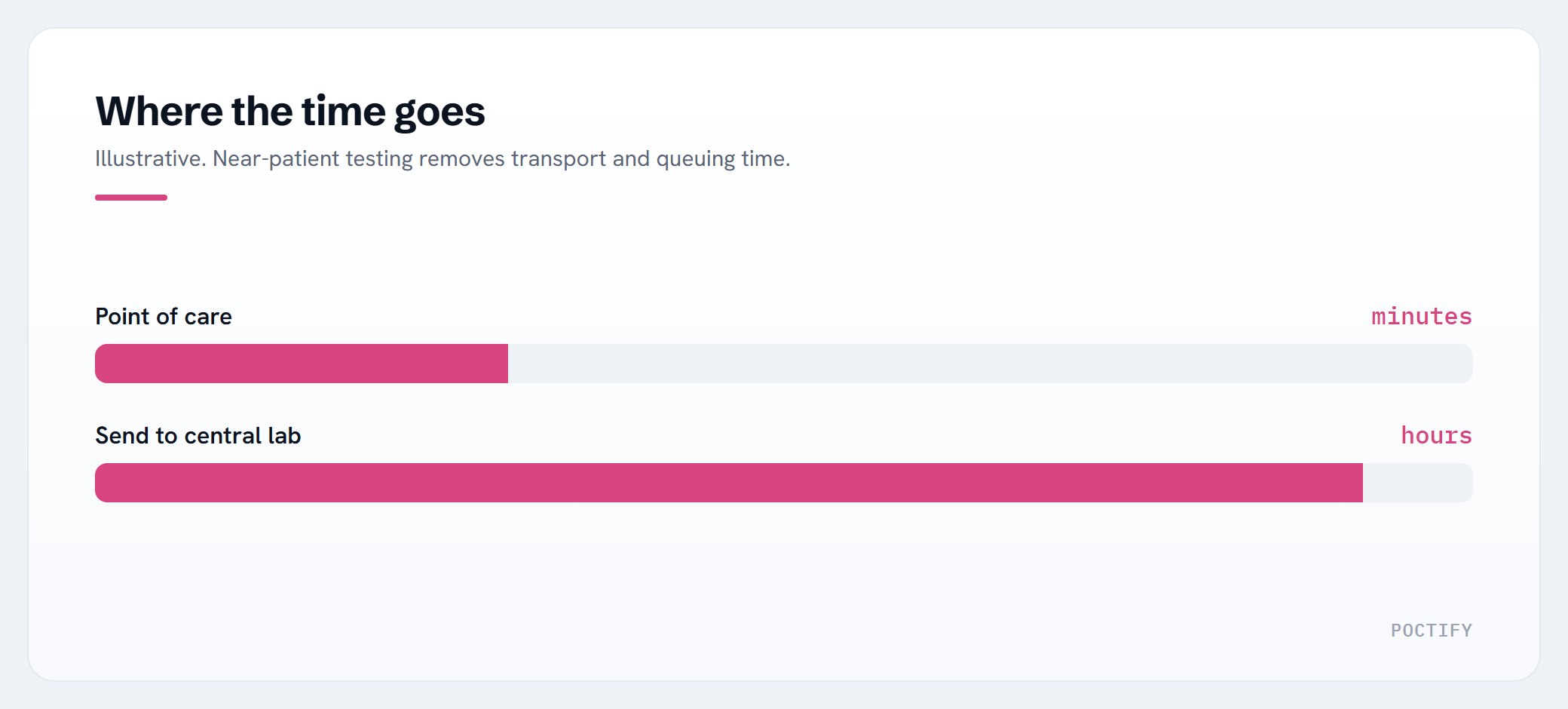
If you own waiting times, you have probably already squeezed the obvious things and watched the clock barely move. That is because turnaround time is not one delay. It is a series of small ones, spread across three stages, and most of them are invisible on the analyser’s own timer.
This guide is about how to reduce laboratory turnaround time without rushing a result or skipping a control. It breaks point of care testing turnaround time into the three places minutes actually hide: before the test, during the test, and after it. The fixes are operational and plain.
First, measure the right turnaround time
There are two clocks, and clinics often watch the wrong one.
The first is analytical time: how long the device takes to produce a number once the sample is loaded. At the point of care that might be a few minutes.
The second is total turnaround time: the gap between ordering a test and someone acting on the result. People call it order-to-action, or less formally vein-to-brain. This is the clock the patient feels, and it is usually many times longer than the analytical time.
If you only measure analyser run time, you will conclude you are already fast and stop looking. Measure order-to-action instead, and time each step. The hidden minutes appear quickly.
To time each step, capture five stamps for a small batch of routine tests: when the order was entered, when the sample was collected, when it was run, when the result became available, and when someone acted on it. The longest gap between two stamps is your first target. You rarely need special tooling for this. A week of honest stopwatch entries across twenty tests will point straight at the stage that is costing you, and it gives you a baseline to measure every later change against.
The three places minutes hide
Before the test: collection, batching and transport
This stage is the biggest and quietest thief. Time disappears into waiting to fill a batch, transporting samples between rooms or sites, re-collecting mislabelled samples that were rejected, and waiting for an order to be entered in the first place.
So how long do blood test results take here? Often longer than the test itself. A sample that waits forty minutes for the next scheduled run has already lost more time than the analyser will ever spend producing the number.
Practical fixes that do not cut corners:
- Stop batching urgent samples. Define clearly which tests are run on arrival rather than on a schedule, and protect that rule.
- Test where the patient is, so the sample does not travel across the building or between sites.
- Standardise order sets so the right test is requested first time, instead of being added as an afterthought once the patient has left.
- Label at the point of collection to cut the recollection loop, which costs a full cycle every time it happens.
During the test: the run itself
This is the analytical time, and it is genuinely shorter at the point of care. Two things still add minutes quietly.
The first is running the wrong menu: sending out a test you could have done in the room. The second is quality control that has lapsed, which forces a repeat run or blocks the sample altogether.
Practical fixes:
- Match your test menu to what changes a decision in the room. Markers like CRP for suspected infection, lactate for an unwell patient, or HbA1c for diabetes review earn their place when the result alters what you do next.
- Keep quality control current and visible, so a control failure is caught before a patient sample is loaded, not discovered after.
- Right-size throughput. Single-sample devices suit urgent work; higher-throughput devices suit routine batches. Mixing the two up adds queueing time.
After the test: retyping, filing and chasing
The result now exists. That does not mean anyone has acted on it. This stage is where a fast analyser quietly gives its time back.
Minutes hide in transcription, where someone reads the screen and retypes the number into the patient record. They hide in filing delays, and in chasing, where a clinician keeps asking where a result has gone. Manual retyping also introduces transcription errors, and a wrong number costs far more time once it is caught.
Practical fixes:
- Remove the retyping step. Let results reach the patient record without anyone keying them in by hand, so the number appears where the clinician is already looking.
- Replace chasing with worklists and alerts, so the result finds the clinician rather than the other way round.
- Set escalation rules for out-of-range or urgent results, so they are flagged at the top of the list instead of sitting unread.
What the evidence says about point-of-care testing
The strongest advantage of point of care testing sits at the before and after stages, because the result lands where the decision is being made.
In a randomised controlled trial published in the Western Journal of Emergency Medicine (2020), the median time from a patient’s arrival to a treatment decision was 106.5 minutes with point of care testing, compared with 204.5 minutes when samples went to a central laboratory. Arrival-to-decision time was roughly halved. Length of stay fell in step, from a median of 395.5 minutes to 240 minutes.
An earlier UK randomised trial published in the BMJ (1998) pointed the same way: clinical decisions were made around 74 minutes earlier for haematology tests and about 86 minutes earlier for biochemistry when point of care testing was used instead of the central laboratory.
One caveat is worth holding onto. Faster only matters when the result changes what happens next in the room. A stat test turnaround time of fifteen minutes adds nothing if the clinician has already moved on, or the number lands in an inbox no one is watching. The real saving comes from pairing a fast result with a fast, reliable path to action.
How to reduce laboratory turnaround time: a practical order of attack
If you want a sequence to work through, this one front-loads the biggest wins:
- Measure order-to-action, not analyser run time.
- Kill batching for anything urgent.
- Cut the distance a sample has to travel.
- Match your test menu to in-the-room decisions.
- Keep quality control current and visible.
- Remove the retyping step entirely.
- Replace chasing with alerts and worklists.
Most clinics find that steps two, six and seven move the clock more than any change to the analyser itself, because that is where the unmeasured minutes were sitting.
Where POCTIFY fits
POCTIFY provides digital solutions for point-of-care testing, tailored to each clinic’s setup. The point is not to make the device run faster. It is to remove the delays around it: results reaching the record without retyping, quality control you can see across every site at a glance, and one shared view of what has been tested and what still needs a decision. It works with the devices and systems you already use, so you are tightening the workflow you have rather than replacing it.
The result is the same test, run to the same standard, reaching the clinician sooner.
This article is operational guidance for running a clinic. It is not clinical or medical advice, and it does not cover how to interpret an individual patient’s result.
Talk it through
If you want help finding where your own minutes are hiding, and a plan to claw them back without cutting corners, Talk to POCTIFY. We are happy to walk through your current workflow and where the practical wins are.
Frequently asked questions
How long do blood test results take with point-of-care testing?
The analytical run is often only a few minutes at the point of care. What patients experience is the total turnaround time, from ordering the test to someone acting on the result. That can run much longer if samples are batched, transported or retyped by hand. Measuring order-to-action rather than analyser run time shows where the real delay sits.
What is a good stat test turnaround time?
Many clinics aim for urgent (stat) results to be available and acted on within about 15 to 30 minutes of collection, though the right target depends on the test and the clinical setting. The number matters less than consistency and, crucially, having a clear path so the result is acted on rather than left sitting unread.
What is the difference between turnaround time and analytical time?
Analytical time is how long the device takes to produce a number once the sample is loaded. Total turnaround time, sometimes called order-to-action, is the gap between ordering the test and someone acting on the result. Total turnaround time is the clock the patient feels, and it is usually far longer than analytical time.
Does point-of-care testing actually reduce turnaround time?
Evidence supports it when the result drives a decision in the room. A randomised trial in the Western Journal of Emergency Medicine (2020) found arrival-to-decision time roughly halved with point-of-care testing, from a median of 204.5 to 106.5 minutes. An earlier BMJ (1998) trial found decisions were made 74 to 86 minutes earlier. The gain depends on pairing a fast result with a fast path to action.
How do we start measuring turnaround time in our clinic?
Pick a small set of common tests and time each step: order entered, sample collected, sample run, result available, result acted on. Look for the longest gap, which is often before the test (batching, transport) or after it (retyping, chasing), not the run itself. Fix the biggest gap first, then re-measure.