

You have decided to pursue UKAS accreditation for your point-of-care testing service, and almost immediately you hit the wall every clinic owner hits: nobody will give you a straight answer on how long it takes or what it costs. UKAS publishes its fees as effort-based indicative figures, your peers quote wildly different numbers, and the official guidance describes a process rather than a price. If you have been searching for how to get UKAS accreditation and getting only vague answers, this article gives you the honest version: the steps in order, a realistic timeline of roughly 6 to 12 months, and where the money actually goes.
What UKAS accreditation for POCT actually means
UKAS, the United Kingdom Accreditation Service, is the national accreditation body recognised by government. For medical testing, including point-of-care testing, it assesses services against ISO 15189:2022, the international standard for quality and competence in medical laboratories. In plain terms, the standard covers your management system, the competence of the people doing the testing, and the whole testing pathway from the request through to the result and how it is safely reported.
There is one change every POCT lead needs to know. Point-of-care testing used to sit under a separate companion standard, ISO 22870. That standard has been withdrawn, and its requirements have been folded into ISO 15189:2022. Your POCT service is now assessed within the same framework as a central laboratory, scaled to what you actually do. You can name and read the standard, but buy the official copy rather than rely on summaries, because the detail matters at assessment.
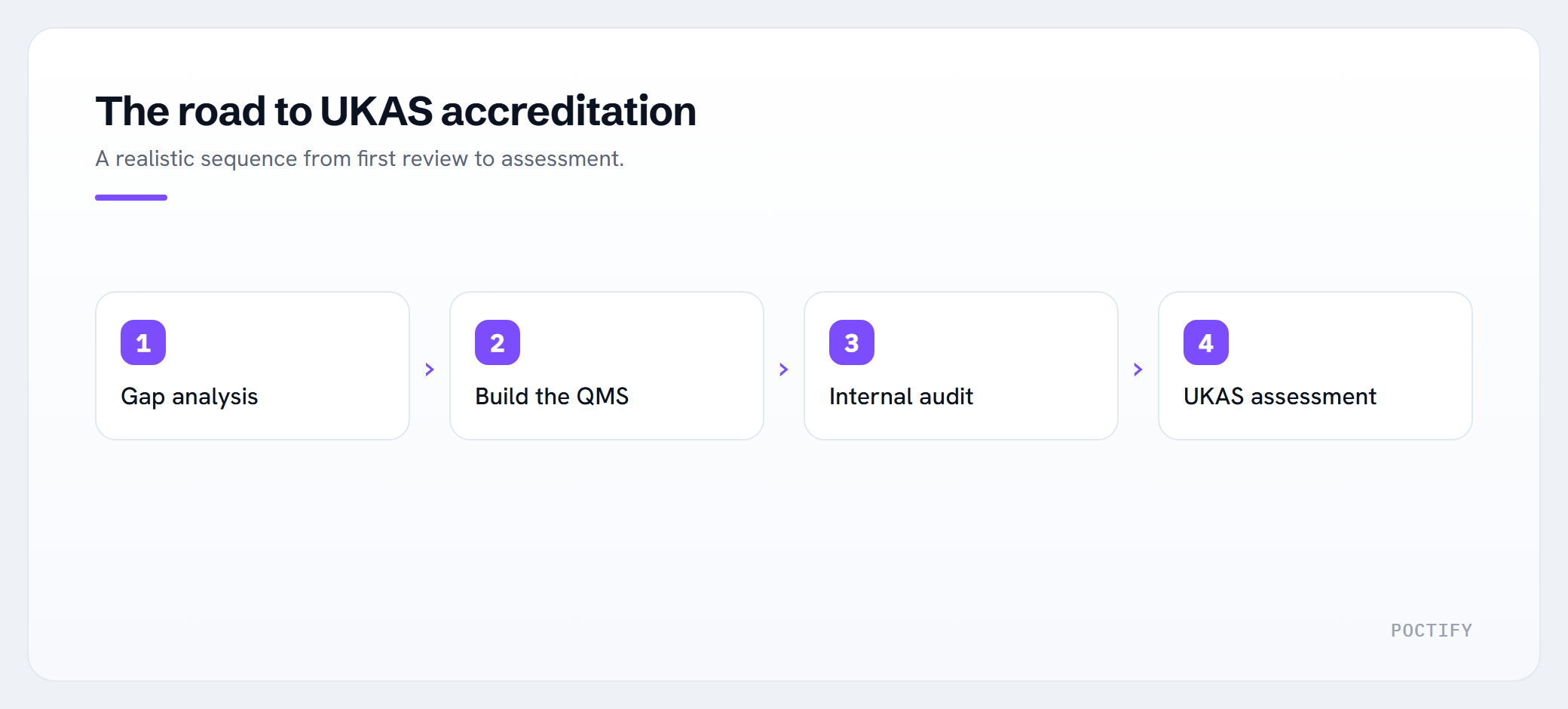
How to get UKAS accreditation: the steps from first enquiry to certificate
1. The readiness conversation
Before any paperwork, have an honest internal conversation about whether your quality management system exists in practice and not just on paper. Many clinics start here and discover they need months of groundwork first. UKAS expects you to have run your system long enough to generate real records: completed internal audits, a management review, quality control data and external quality assessment results.
2. Application
You submit a formal application to UKAS defining your scope: the tests, the sites and the devices in question. Scope drives everything that follows, including cost, so define it deliberately. A tighter, well-evidenced scope is cheaper and faster to assess than a sprawling one you cannot fully support.
3. Gap analysis or pre-assessment
This step is optional, and worth it for most first-time applicants. A pre-assessment is a lighter-touch visit where an assessor flags gaps before the real thing. It costs assessor time, but it almost always saves money overall by preventing findings at initial assessment that would otherwise stall you.
4. The initial assessment
This is the on-site assessment. Assessors review your documented system, then test it against reality. They watch testing, interview operators, check competency records, trace quality control and external quality assessment, and follow individual results through your process. For a small single-site POCT service this is usually a small number of assessor days; broader scopes take longer.
5. The findings response window
Almost no service passes with zero findings. You will receive nonconformities to address, and you are given a defined window to respond with corrective action and evidence. How quickly you close findings is largely within your control, and it is one of the biggest levers on the total timeline.
6. The accreditation decision
Once findings are cleared and reviewed, UKAS makes the accreditation decision and issues your schedule of accreditation, listing exactly what you are accredited for.
7. The four-year cycle
Accreditation is not a one-off certificate. It runs on a four-year cycle with annual surveillance visits to confirm you are still meeting the standard, and a fuller reassessment before the cycle renews. Budget for this from the start, because the recurring effort and fees are part of the real cost, not an afterthought.
The realistic timeline: 6 to 12 months
Here is the honest answer. For a clinic that is genuinely ready, 6 months is achievable. For one starting from a partial system, 12 months or more is common. The published process steps are not the slow part. The slow part is you.
Where the time actually goes:
- Building or maturing the quality management system: weeks to many months, depending on your starting point.
- Generating a track record: you need internal audits, a management review and several months of quality control and external quality assessment data before an assessment is meaningful.
- Waiting for assessment dates: UKAS scheduling adds lead time you do not control.
- Closing findings: days if your evidence is at hand, weeks or months if you have to reconstruct records.
A service with clean, current records moves through every one of these faster.
The costs nobody quotes upfront
UKAS fees are effort-based, which is precisely why you cannot get a single sticker price. The total depends on your scope, your number of sites and how many assessor days your assessment needs. The structure stays consistent even when the figures do not:
- A one-off application fee.
- An optional pre-assessment, charged per assessor day.
- The initial assessment, charged by assessor days.
- An annual fee plus surveillance assessment days every year.
- A reassessment toward the end of the four-year cycle.
As a planning figure, a small single-site POCT service should expect UKAS fees running into several thousand pounds in year one, then a recurring annual cost for surveillance, with more for broader scopes and additional sites. Treat that as indicative only, and ask UKAS for a quote against your defined scope, because day rates and fees are set and updated by UKAS, not by us.
The cost that dwarfs the fees
The UKAS invoice is rarely the biggest number. The larger spend is internal:
- Staff time to write, run and audit the quality management system.
- External quality assessment scheme subscriptions for each analyte you report.
- Quality control materials, and the time to run and review them.
- Training and competency assessment for every operator.
- Possibly consultancy support or a quality manager’s time.
These are the costs nobody quotes upfront, and they are where most of the year disappears.
Where the delay and cost really hide
Almost everything expensive about accreditation traces back to one thing: your state of readiness. Assessors are charged by the day, and findings extend the timeline. Both shrink when your evidence is complete, current and quick to produce.
That is the practical case for getting your records in order before you apply. When an assessor asks to see six months of quality control for a device, the competency file for a named operator, or the external quality assessment results for HbA1c, the difference between “here it is” and “give me a week” is measured in assessor days and in findings. Clean, complete, time-stamped records that work with the devices and systems you already use turn a tense assessment into a confirmation exercise.
This is the gap POCTIFY is built to close. A digital record that captures quality control, operator competency, device history and result trails as testing happens means the evidence already exists when the assessor arrives, rather than being assembled in a panic the week before.
A short readiness checklist
- A documented quality management system that staff actually follow.
- A defined scope: tests, sites and devices.
- Several months of internal quality control data, reviewed and signed.
- Enrolment and a track record in external quality assessment for each analyte you report, for example HbA1c, CRP or lactate.
- Operator competency records for everyone who tests.
- At least one completed internal audit and one management review.
- A named person who owns the system.
If you can tick those honestly, 6 months is realistic. If you cannot, fix readiness first. It is far cheaper than failing an assessment.
This article is educational and operational only. It is not medical advice, and it is not a substitute for the official ISO 15189:2022 standard or current UKAS guidance, which you should consult directly.
Talk to POCTIFY
Thinking about accreditation and not sure your records would survive an assessment? Talk to POCTIFY about readiness support tailored to your clinic. We will help you get the evidence in order so that the assessment becomes the easy part.
Frequently asked questions
Do I need ISO 15189:2022 or ISO 22870 for POCT accreditation?
ISO 22870, the old companion standard for point-of-care testing, has been withdrawn. Its requirements are now part of ISO 15189:2022, so your POCT service is assessed within that single standard, scaled to the testing you do. Buy and read the official copy rather than relying on summaries.
How long does UKAS accreditation for POCT take?
Roughly 6 to 12 months. A clinic that is genuinely ready, with a working quality management system and several months of records, can reach assessment in about 6 months. Starting from a partial system, 12 months or more is common. Readiness, not the UKAS process itself, is usually the slow part.
How much does UKAS accreditation cost?
UKAS fees are effort-based, so there is no single sticker price. Expect a one-off application fee, assessment charged by assessor days, an annual fee and surveillance days, and a reassessment in the four-year cycle. A small single-site service should budget several thousand pounds in year one and ask UKAS for a quote against its defined scope.
Can a small private clinic get UKAS accredited for POCT?
Yes. Accreditation is scaled to your scope, so a single-site clinic running a handful of tests is assessed against the parts of ISO 15189:2022 that apply to it. A tighter, well-evidenced scope is also faster and cheaper to assess than a broad one you cannot fully support.
What causes most delays and findings during assessment?
Incomplete or hard-to-find records. Assessors are charged by the day and findings extend the timeline, so missing quality control logs, gaps in operator competency files or thin external quality assessment history are the usual culprits. Clean, current, time-stamped records shorten the assessment and reduce findings.